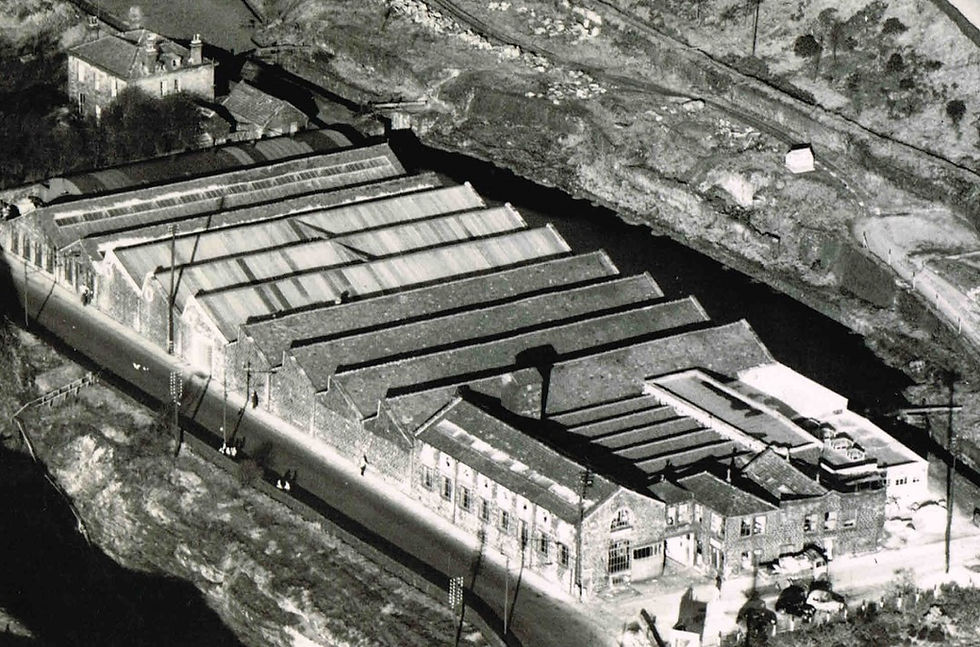
Littleborough from Cleggswood Hill
FOTHERGILL & HARVEY - probably the most progressive Company in Littleborough
Around 1846 to 1848 three Cotton and Yarn Agents in Manchester, Alexander Harvey and Thomas Fothergill and one other formed a very successful and profitable partnership an office in the centre of Manchester. They must have considered that cloth manufacturing would increase supplies so they entered into a partnership with their friend Thomas Livesey who had recently set up a mill in Well ’th Lane in Rochdale, Unfortunately, not that long afterwards the mill, its textiles and its new machinery together with the Livesey’s house was destroyed by fire. undeterred they sought opportunities in Littleborough. One of the earliest mills in the Summit area of Littleborough Sladen Mill up in the Sladen Valley mentioned in a 1792 survey for the Rochdale Canal. Subsequent developments included Pike House Fulling Mill in 1845 and Green Vale Mill was built around 1846/7. 1847/49 saw Sladen Wood Mill built between the Rochdale Canal at Punchbowl lock and the 1824 Turnpike Road and accompanying railway. Across the canal. late 1852 to Summer 1853 saw the erection of the 'Backing Hole Shed' in a small quarry on the eastern side of the canal a little south of the lane up to Sladen. In 1858 Alexander Harvey obtained a part of Sladen wood Mill subsequently taking over the other 2 parts. The early to mid 1860s suffered from a reduction in cotton supplies due to the American Civil War. Known as the Cotton Famine it meant hard times across Lancashire especially for smaller companies and as a result the owners of the Backing Hole shed. Alexander Harvey conducted negotiations with a trustee of the estate and at the turn of the year the deeds for Rock Nook were his. Backing Hole (now more regularly known as Rock Nook) was slightly larger than Sladen Wood with initially 106 looms when acquired by Alexander in 1872. Later, Alexander Harvey and his sons bought additional land close to the Backing Hole Shed. Thomas Fothergill ran Sladen Wood Mill from around 1858 and lived in lived in Sladen House with his family until his early death in 1866. In this era these mills made a rather coarse cloth of poor quality.
GORDON & ERNST HARVEY
Gordon Harvey aged 21, arrived in Summit in 1879 and moved into Sladen Wood House previously occupied by Anne Fothergill (widow) and her daughters including Jessie, a well known local author. His day started at 6.00am at which time he could often be seen about the mill discussing with some of the weavers about how to improve the quality of the cloth and improve productivity which in turn would lead into more efficient operations and more profitable operations. This lead to the manufacture of Drill cloth at Sladen Wood Mill, which became the Company's main output (together with Jean Cloth) until the mid 20th C. He soon observed the poor conditions experienced by the operatives with looms positioned too close together, no heating or ventilation, nowhere to dry wet clothes or eat. Gordon sensed that the poor working conditions conducive to quality and productivity. An early innovation was the provision of dry socks for women workers when they entered the mill. Gordon also believed that the mills were too small for profitable operations. An opportune moment came when land adjacent to Rock Nook Mill was bought in 1886 which enabled a new 5 storey Rock Nook to be built during 1886. In 1888 Sladen Wood was extended by around 70 feet. By 1888 the mills at Summit had benefitted from new machinery for both spinning and weaving The new mill was extended over the years (with the left hand tower carrying a datestone of 1898) enabling a canteen to be built in the old boiler house. Around 1886 or 1888 Gordon’s younger brother Ernst joined him in Summit and he too lived in Sladen Wood House. Whilst Gordon was a strict uncompromising man, over the years the workers grew to respect him. Ernst however, was a completely different character, sporting and humorous, he had a good rapport with the workers virtually knowing each employee by name and had a keen interest in mechanics. This enabled more organised and efficient operation. The Backing Hole shed was extended further south and in 1892 a new warehouse was built adjacent to the extension (see centre picture below). Even more expansion at Summit required acquisitions and one option became possible around 1890/93 when Green Vale Mill was leased by Joseph Schofield & Co.to Fothergill and Harvey. It was later purchased outright.
FOTHERGILL and HARVEY – Cloth and Yarn Agents
The Company's main office was located in Manchester, It was here and the Royal Exchange where the main profits were generated which were key to improvements and expansions in Summit. As the workload increased so the HQ was constantly on the move into larger premises. Around 1879 Charles (also a keen sportsman) joined his father in the Manchester Office with Harry arriving later. By 1891 Sidney had joined his brothers but it soon became obvious that the pressure of the work was not for him and he gradually withdrew from the Manchester Office.
KHAKI DRILLS
Gordon Harvey as an MP was very concerned about the British Casualties in the Boar War where the Rad tunics stood against the sandy backdrop. Being aware of a Khaki cloth in India and became determined to create it in England. working with local dyers this was achieve by Samuel Bowden of Grove
Dyeworks in 1895/6. Using contacts within the War Office enabled the Army to have sufficient Khaki cloth prior to the the 2nd Boer War. Khaki cloth was exported to many military including a light version for India. A lighter weight drill was produced for the market in India for use in the production of Jeans. The size of the profits made out of khaki led to criticisms of Gordon Harvey, a pacifist. Characteristically, Fothergill and Harvey used the profits gained from Khaki cloth to improve the equipment in the mills but they also continued to working conditions implemented early, child labour starting at 12 years old instead of nine, warm mild served to children at the start of worker, safer distance between looms, better places to eat and dry cloths, a Social club for its employees and develop a Pension Fund.
POLITICS
Besides Gordon being a local MP, he and Ernst were involved in local politics with special interest in education with Gordon pushing the local School board which built 3 new Board Schools. Ernst had a keen u=interest in pushing technical education.
The growth in the 19th Century put them in comfortable position to face the changing 20th Century.